
Be Careful with Self-Care
There’s been a growing interest in wellbeing in recent years, which is, of course, a good thing. But a lot of the attention, at least the kind that tends to cross my path, is heavily focused on self-care, often as if it’s the best (or even only) route to feeling better. I don’t want to be arguing against self-care, but it’s important to keep in mind that this emphasis can be misleading, and in a way that leaves both the individual and the people around them missing out.
The core issue here is that a lot of the talk on self-care is based on a mistaken assumption: we think caring for ourselves and caring for others as if they sit on opposite ends of a single continuum, where more of one automatically means less of the other. But humans are social beings and we need to integrate that aspect into our models of wellbeing. What energizes you can also help others, and supporting others can give you a real boost!
A Better Map of Wellbeing
A clearer way to think about this is as two axes, not one. You can care more or less for yourself, and more or less for others, and those dimensions move independently. When mapped that way, the landscape becomes more open and more realistic.
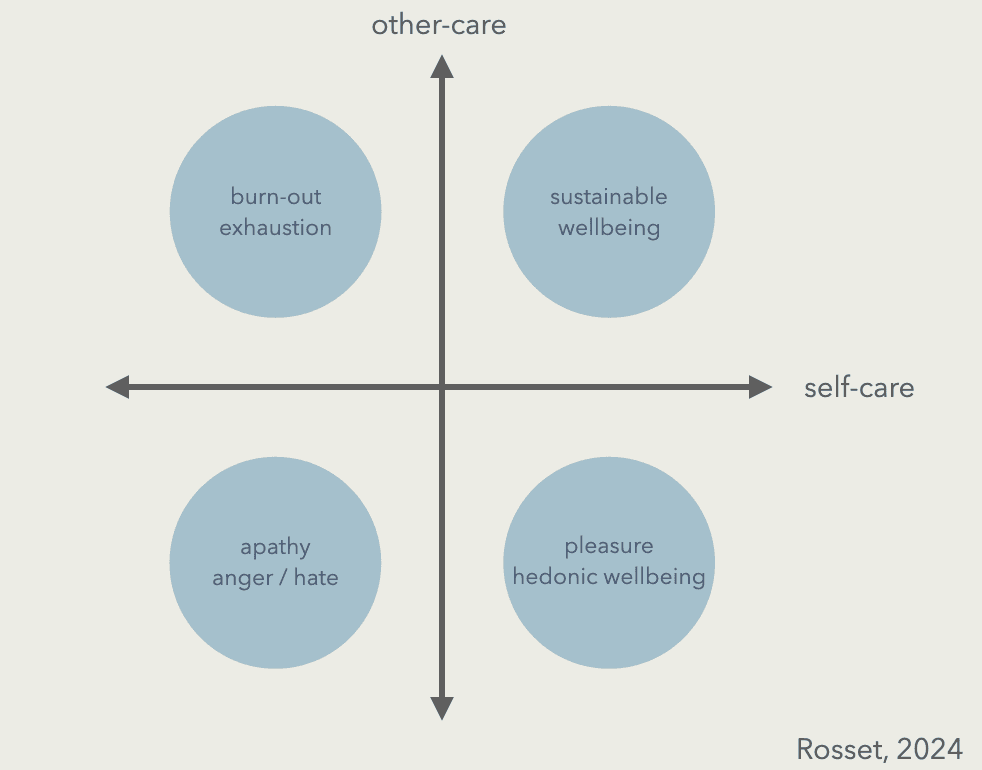
Moving from the top left, clockwise:
High other-care + Low self-care
You’re taking care of others but neglecting yourself. This is where burnout happens.
High self-care + High other-care
This is the win-win quadrant. You’re feeling grounded and resourced, and you’re contributing and connecting in ways that feel natural. This is the zone of sustainable wellbeing.
High self-care + Low other-care
You’re doing pleasant, restorative things for yourself, but they don’t necessarily involve anyone else. This is the familiar “treat yourself” space.
Low self-care + Low other-care
You’re not tending to yourself and not engaged with others either. This is where apathy and anger come in.
No one wants that bottom-left quadrant. The top-right seems the place to be.
How to Reach the Upper-Right Quadrant
The encouraging part is that we already know how to get there! The same ingredients that make any activity feel intrinsically enjoyable apply here. We need real choice in what we do. We need to feel reasonably confident in it. And we need some sense of connection in the process. These three needs, the core of self-determination theory, are what make an experience energizing rather than draining.
When these needs are met, the activity feels good in its own right. When they’re missing, almost anything feels like a chore. The key is to build these needs into the ways we help others.
Make Contribution Your Own
One of the simplest ways to do that is to design your own version of contribution. Create something that fits you. Personalizing what you offer almost automatically meets those three needs: it gives you choice, taps into strengths you already have, and creates a form of connection that is meaningful to you.
A few examples to illustrate: If you love bird-watching, offer a short lunchtime introduction to colleagues who might be curious. If you enjoy baking, make a double batch of something and bring the extra to a local shelter or community fridge. These small acts land in the upper-right quadrant because they feel like you, and they genuinely support someone else.
The beauty of approaching contribution this way is that it lasts. It doesn’t drain the person doing it, and it often makes a meaningful difference to the people who receive it.
In the end, individual wellbeing and collective wellbeing sometimes do pull in different directions, but less often than we assume. And it’s worth making it a priority to notice all the places where one strengthens the other.